Spider
Also known as Spider Solitaire and Spider Patience
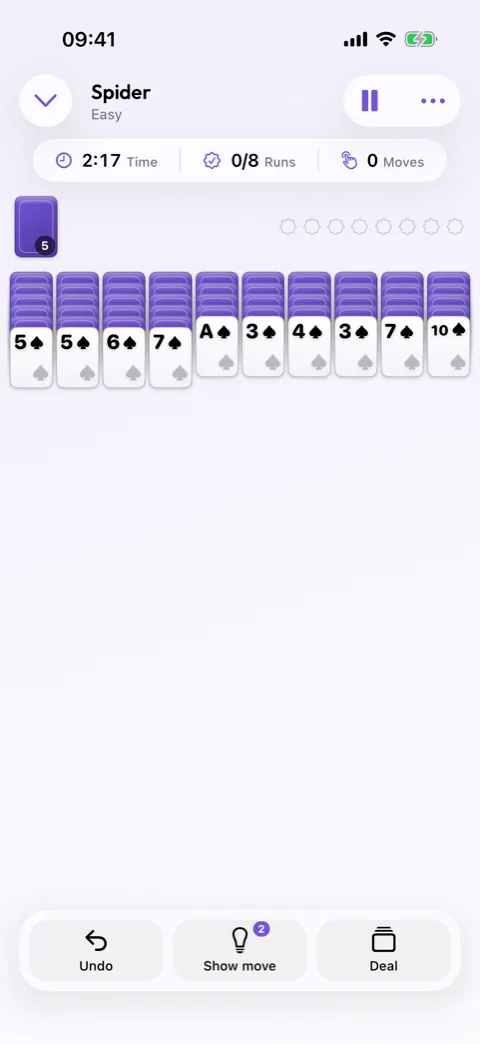
The harder patience game. Build eight complete runs from king down to ace and each one leaves the board. You can stack any card on one a rank higher regardless of suit — but only a run in a single suit moves as a group, so keeping suits together is what keeps your cards useful.
How it works
- Build eight complete runs from king down to ace. A finished run leaves the board.
- Stack any card onto one a single rank higher — suit does not matter when building.
- Only a run in one suit can be moved as a group, so matching suits is what keeps cards useful.
- Dealing adds one card to every column, so every column must be filled first.
- Deals are shuffled, so not every one can be won. End the deal from the ⋯ menu to take a fresh one.
Good if you want…
- A card game that puts up a real fight
- One, two or four suits depending on how brave you feel
- A long game rather than a quick one
How to win at Spider
Build in suit whenever you can
Any card can go on one a rank higher, whatever the suit — but only a run in a single suit moves as a group. So when you have a choice, put the eight of hearts on the nine of hearts rather than the nine of spades. Mixed-suit runs are not wrong, but they are stuck until you take them apart card by card.
Empty columns are gold
In Spider an empty column can take any card, not just a king. That makes it the most powerful thing on the board: a place to park a card while you rearrange two others, or to split a mixed run back into suits. Work towards emptying a column early, and think carefully before filling one.
Expose face-down cards
As in Klondike, the cards you need are buried. Favour moves that turn a face-down card over, and pay most attention to short columns, which are the easiest to clear entirely.
Deal only when you must
Dealing puts a card on every column, which covers every run you have been building. Before dealing, make every useful move you can — in particular, tidy runs into single suits, since the new cards will sit on top of them. Every column must have at least one card before you can deal.
Choose your suits
Spider can be played with one, two or four suits. One suit is gentle and a good way to learn; two suits introduces the real decisions about building in suit; four suits is one of the hardest patience games there is, and even strong players lose a good share of deals.
Common mistakes
- Building off-suit when an in-suit move is available.
- Filling an empty column with a card that could have gone elsewhere.
- Dealing early to see what comes out. It buries every run on the board.
Where Spider comes from
Spider is played with two packs, 104 cards in all, and has been one of the most popular patience games for well over a century. It found a huge new audience when it was included with Windows at the turn of the millennium.
Spider questions
How is Spider different from Solitaire?
You build down regardless of suit, a finished king-to-ace run leaves the board, and any card can go in an empty column. The aim is eight complete runs rather than four foundations.
Is every deal winnable?
No — deals are shuffled, and four-suit Spider in particular loses a lot of them. You can end a deal from the ⋯ menu and take a fresh one.
Spider in Winters Puzzles
Spider is one of 40 puzzles in Winters Puzzles, so it sits alongside Solitaire and everything else in the app rather than being a download of its own. It counts towards your stats and streak like any other puzzle. It is not one of the puzzle types included in Pip’s dailies.

Play Spider.
Free on iPhone and iPad, with 39 other puzzles alongside it. Or play it in your browser — no download, nothing to sign up for.