Sudoku
Also known as Number Place
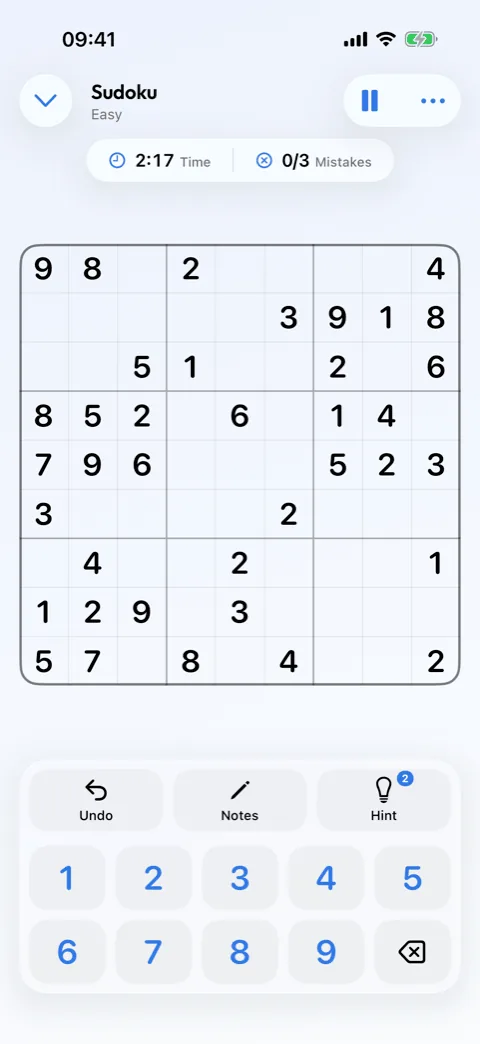
The classic number puzzle: a nine-by-nine grid where every row, column and box has to hold each digit from one to nine exactly once. Winters Puzzles generates a fresh board every time you play, checks it has exactly one solution before dealing it, and lets you pencil in candidates while you work.
How it works
- Every row, column, and 3×3 box holds 1–9 exactly once.
- Tap a cell, then a number. Tap the number again to clear it.
- Notes mode pencils in candidates you're not sure about.
Good if you want…
- A puzzle you already know the rules to
- Somewhere between five minutes and half an hour
- Choosing your own difficulty, from gentle to genuinely hard
How to solve Sudoku
Start with the singles
Most of an easy board falls to two ideas. A naked single is a square with only one digit left that it could hold: look along its row, down its column and around its box, and if eight of the nine digits are already there, the ninth is the answer. A hidden single turns the question round — pick a digit and a box, and if there is only one square in that box where the digit can still go, it goes there, whatever else that square could have held.
Hidden singles are the faster of the two to spot. Sweep one digit at a time across the whole grid — every 1, then every 2 — and look at each box for the one gap the digit is not blocked from. Most people find a board opens up much faster this way than by staring at single squares.
Pencil in candidates when the singles run out
Medium boards reach a point where no single is visible without writing things down. That is what notes mode is for: pencil every possible digit into the empty squares of one box or one row, then look for patterns in the notes rather than in the grid.
The first pattern worth knowing is the naked pair. If two squares in the same row, column or box can each only be 4 or 7, then between them they hold the 4 and the 7 — so no other square in that unit can be either. Clear those digits from the rest of the unit and a single usually appears. The same logic extends to three squares sharing three candidates.
Pointing pairs and box–line reduction
If, inside one box, every place a digit can go lies in the same row, then that digit is in that row within that box — and nowhere else in that row. Rub it out of the rest of the row. This is called a pointing pair (or triple), and it is the technique that most often unsticks a hard board.
The reverse also works: if every place a digit can go in a row falls inside one box, the digit cannot appear anywhere else in that box.
The X-wing, for expert boards
Pick a digit. If, in two different rows, it can only go in the same two columns, those four squares form a rectangle, and the digit must sit on two opposite corners of it. Either way round, both columns are used up — so the digit can be removed from every other square in those two columns. It sounds exotic, but once you have seen one you start noticing them, and expert boards are often built around exactly one.
Common mistakes
- Guessing. A board generated with one solution never needs a guess, and a guess that happens to be right teaches you nothing about the next board.
- Letting notes go stale. When you place a digit, clear it from the notes in the same row, column and box straight away, or the notes start lying to you.
- Only ever looking at squares. Asking "where can the 6 go in this box?" finds placements that "what goes in this square?" never will.
Where Sudoku comes from
The puzzle was first published in 1979 in Dell Pencil Puzzles and Word Games in the United States, under the name Number Place, and is usually credited to Howard Garns. The Japanese publisher Nikoli took it up in 1984 and gave it the name Sudoku, a shortening of a phrase meaning "the digits must remain single". It reached British newspapers in late 2004 and became a craze within months.
Sudoku questions
Does a Sudoku need any maths?
None. The digits are just nine different symbols — the puzzle would work exactly the same with nine letters or nine colours. What it asks for is careful elimination.
Can a Sudoku have more than one solution?
A badly made one can, and then the last few squares come down to a coin toss. Every board in Winters Puzzles is checked for exactly one solution before it is dealt, so there is always a reason for every digit.
What makes one Sudoku harder than another?
Not the number of starting digits so much as the techniques it needs. An easy board falls to singles alone; a hard one needs pairs and pointing; an expert board needs something like an X-wing at least once.
Sudoku in Winters Puzzles
Sudoku is one of 40 puzzles in Winters Puzzles, so it sits alongside Nonogram, KenKen, Kakuro and everything else in the app rather than being a download of its own. It counts towards your stats and streak like any other puzzle. It also has a published board in Pip’s dailies, with earlier dates available in the archive.

Play Sudoku.
Free on iPhone and iPad, with 39 other puzzles alongside it. Or play it in your browser — no download, nothing to sign up for.