Nonogram
Also known as Paint by Numbers, Hanjie, Japanese Crossword and Picture Logic
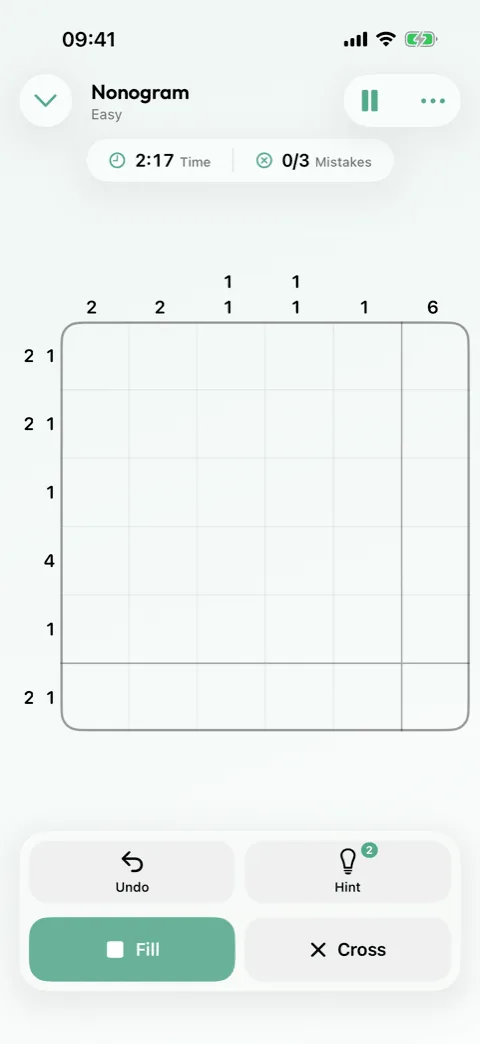
A picture logic puzzle, also known as picross or paint-by-numbers. The numbers along each row and column tell you how many squares to fill and in what order; work out which is which and a picture appears. Every board is checked for a single solution, so it can always be reasoned out.
How it works
- The numbers say how many squares to fill in a row or column, in order.
- “3 1” means a block of 3, a gap, then a block of 1 — with at least one empty square between.
- Cross out squares you know are empty. Crossing is free and never counts as a mistake.
- Drag to fill or cross a run of squares in one go.
Good if you want…
- Logic without any arithmetic
- A picture at the end rather than a filled grid
- Working up from a 10×10 board to a 15×15 one
How to solve Nonogram
Find the overlaps first
The first move on any nonogram is arithmetic you can do at a glance. Take a row ten squares long with a clue of 7. Push the block as far left as it will go and it covers squares 1–7; push it as far right and it covers 4–10. Whichever it really is, squares 4 to 7 are filled. In general a single block of length k in a line of n squares fills the middle 2k − n squares, whenever that is more than zero.
The same trick works for several blocks at once. Add up the clues plus one gap between each: a row of 10 with clue "3 1 4" needs 3 + 1 + 4 + 2 = 10 squares, so it is fully determined before you have looked at anything else. Scan every row and column for big clues like this before doing anything subtle.
Use the edges and the crosses
A filled square touching the edge of the board starts a block — so if a row's first clue is 3 and its first square is filled, the next two are filled and the square after them is empty. Filled squares near an edge push blocks into place the same way.
Crossing out is half the puzzle. Once a row's clues are all accounted for, cross every remaining square. Those crosses become information for the columns running through them, and a column with a few crosses in it often has only one place left for its block. Crossing is free and never counts as a mistake, so do it generously.
Work the whole board, not one line
Every square you settle is a clue to the line running the other way. The rhythm of a good solve is to go across every row, then down every column, then across again, each pass picking up what the last one made possible. When a pass finds nothing, look for the line with the fewest unknown squares — it is usually the one that gives.
Reaching larger boards
On a 15×15 board the clues get shorter relative to the lines, so overlaps are rarer. The technique that takes over is reasoning about which block a filled square belongs to: if a row reads "2 5" and there is a filled square in the first third of the line, it can only be part of the 2, which caps how far right that 2 can reach and pushes the 5 along with it.
Common mistakes
- Filling a square because it "looks like" the picture. The image only appears at the end; until then, every square needs a reason.
- Forgetting the gap. Two blocks in the same line always have at least one empty square between them.
- Leaving squares blank that you know are empty. An uncrossed square is one you will have to re-check later.
Where Nonogram comes from
Nonograms were invented independently in Japan in 1987 by the graphic designer Non Ishida and the puzzle maker Tetsuya Nishio. The name joins Ishida's first name to "diagram". A British newspaper began printing them weekly in 1990, and they have since gone by many names — paint by numbers, Hanjie, griddlers, picross.
Nonogram questions
What do the numbers in a nonogram mean?
Each number is a block of consecutive filled squares, and the numbers are in order. "3 1" on a row means a block of three, then at least one gap, then a block of one, reading left to right.
Do I ever need to guess?
Not on a board with one solution, and every board here is checked for exactly that. If you are stuck, a line somewhere has an overlap or an edge you have not used yet.
Why cross out squares at all?
Because an empty square is information. A column that has five squares crossed out has far fewer places for its block, and that is often what decides it.
Nonogram in Winters Puzzles
Nonogram is one of 40 puzzles in Winters Puzzles, so it sits alongside Sudoku, KenKen, Kakuro and everything else in the app rather than being a download of its own. It counts towards your stats and streak like any other puzzle. It also has a published board in Pip’s dailies, with earlier dates available in the archive.

Play Nonogram.
Free on iPhone and iPad, with 39 other puzzles alongside it. Or play it in your browser — no download, nothing to sign up for.