Logic Grid
Also known as Logic Puzzle, Einstein Puzzle, Zebra Puzzle and Einstein’s Riddle
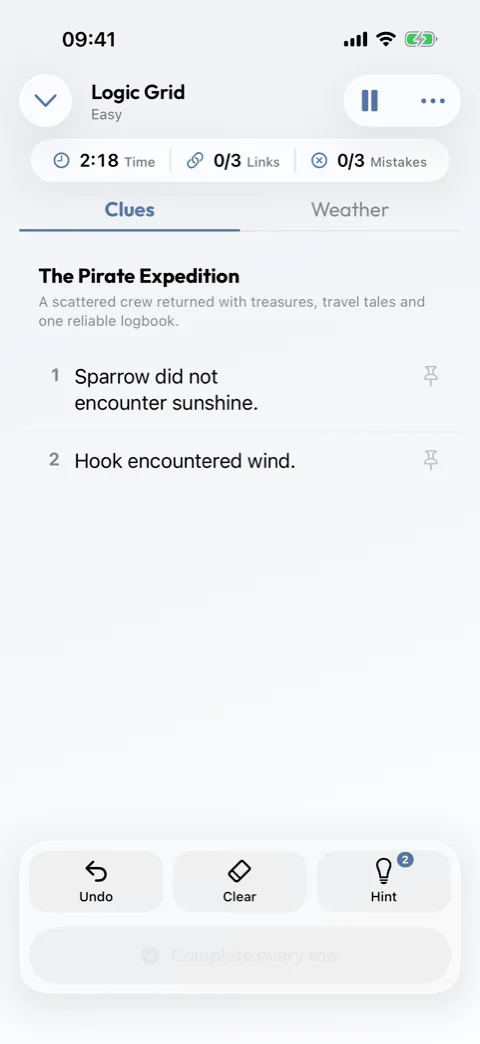
The classic grid-and-clues deduction puzzle. Every row matches exactly one item from each category, and the clues together settle every pairing — you are never asked to guess. The cast and the topics change every round.
How it works
- Every row matches exactly one item from each category — the cast and topics change every round.
- Tap to rule a pairing out — crossing out is how the grid is solved. Tap again to pin it.
- The clues together settle every pairing. You never have to guess.
- Only submitting a finished grid can be wrong — mark and unmark as much as you like.
Good if you want…
- The longest, most involved deduction in the app
- Reading clues and working carefully
- A puzzle where nothing is ever left to chance
How to solve Logic Grid
Cross out before you tick
Most clues say what is not true — "the baker is not Anna", "the person with the cat lives somewhere after the person in blue". Mark every one of those as a cross first. A logic grid is solved far more by crossing out than by pinning, and a row with every square but one crossed has only one answer left.
When you pin one, cross the rest
The moment a pairing is certain, everything else in its row and column within that block becomes a cross, because each item matches exactly one other. This is the step that makes a grid cascade: one confirmed pair often clears five or six squares at once.
Carry facts across blocks
The grid is split into blocks, one for each pair of categories. If Anna has the cat, and the cat's owner lives at number 3, then Anna lives at number 3 — and that has to be marked in a block neither clue mentioned directly. Checking every confirmed pair against the other blocks is the habit that separates getting stuck from finishing.
Read ordering clues as ranges
Clues like "somewhere before" or "two places after" rarely give a pairing outright, but they rule out ends. If A comes before B, then A cannot be last and B cannot be first. Two ordering clues together often pin an item to one position.
Reread the clues at the end
When the grid stalls, go through every clue again. A clue that told you nothing at the start often decides a pairing once half the grid is filled, and the clues together always settle every pairing — you never have to guess.
Common mistakes
- Ticking a pairing because it seems likely. Only pin what a clue, or the grid itself, forces.
- Treating "not next to" as "not before". Ordering clues say exactly what they say and no more.
- Forgetting to update other blocks. A fact found in one block is usually needed in another.
Where Logic Grid comes from
The best-known logic grid puzzle, often called the Zebra Puzzle, was published in Life International in 1962. It is widely called Einstein's Riddle, though there is no evidence Einstein had anything to do with it.
Logic Grid questions
Can I submit a grid with mistakes in it?
You can mark and unmark as much as you like; only submitting a finished grid can be wrong.
Why cross out rather than tick?
Because most clues are negative, and because a row with one square left uncrossed is proven — while a tick placed on a hunch is not.
Logic Grid in Winters Puzzles
Logic Grid is one of 40 puzzles in Winters Puzzles, so it sits alongside Patch, Pippin, Code Breaker and everything else in the app rather than being a download of its own. It counts towards your stats and streak like any other puzzle. It also has a published board in Pip’s dailies, with earlier dates available in the archive.
Play Logic Grid.
Free on iPhone and iPad, with 39 other puzzles alongside it. Or play it in your browser — no download, nothing to sign up for.