Silhouette
Solve clued words from the shapes of their letters. Tall letters rise, letters with tails dip, and plain letters sit on the line. Each correct answer opens the next clue. Free play has four words around a theme; the daily gives every player the same published clues and answers at its chosen difficulty.
How it works
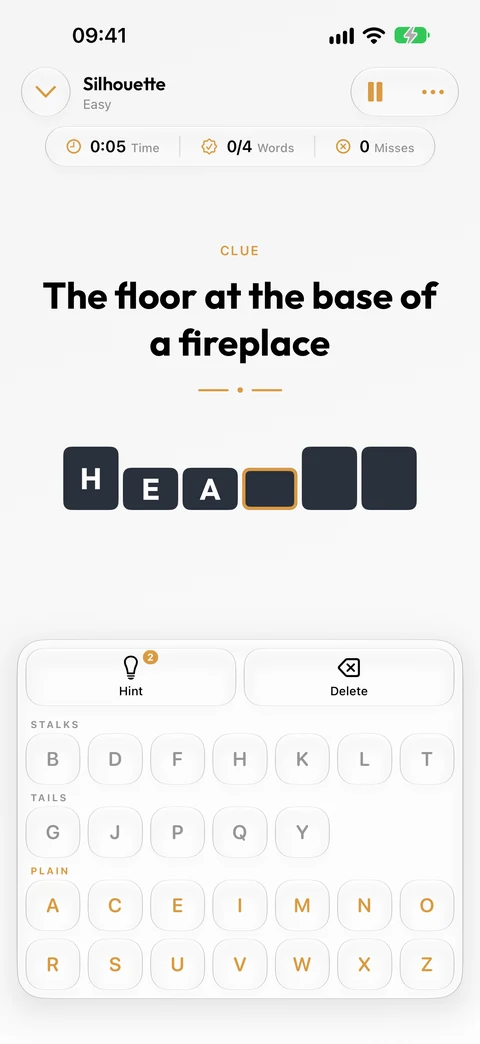
- Solve one clued word at a time. Each block shows a tall, tail or plain letter.
- Choose a block, then tap or type a letter from the matching keyboard group.
- Easy gives one letter on words of seven or more letters. The other tiers give no letters, and in free play each picks words whose shapes give less away than the tier below.
- A complete wrong word adds one miss and clears your letters in that word. Misses never end the round.
- You get one free hint for the whole puzzle, and it reveals and locks a useful letter. Solve every clued round to finish.
Good if you want…
- Short word puzzles with clues
- Using letter shapes to narrow down an answer
- A daily word puzzle without a mistake limit
How to solve Silhouette
Know the three shapes
Every block is the outline of a lowercase letter. Tall blocks take the seven letters that rise above the line: B, D, F, H, K, L and T. Tail blocks take the five that dip below it: G, J, P, Q and Y. The other fourteen letters are plain, including I, whose dot does not count. The keyboard is grouped the same way.
All five vowels are plain, so a tall or tail block is always a consonant or a Y. J and Q are rare, so a tail block is nearly always a G, a P or a Y, which makes tails the easiest blocks to guess.
Let the clue suggest, let the outline decide
Read the clue and count the blocks, then think of two or three answers before typing anything. The outline is your test. If the clue asks for a season and there are six blocks, all four seasons are the right length, but only one fits. A tall third block means AUTUMN, a tall fourth means WINTER, tails second and last mean SPRING, and six plain blocks mean SUMMER.
Sometimes the outline cannot choose. POOL and POND are both a tail, two plain blocks and a tall one, so only the clue can separate them. When two candidates share an outline, read the clue again before you fill the last block.
Read the endings first
Endings have shapes you soon learn to spot. -ING is two plain blocks and a tail, -LY is tall then tail, and -ED is plain then tall. -TION is one tall block and three plain ones, and -GHT, as in NIGHT, is a tail followed by two tall blocks. A tail in the last place is most often a Y.
You can fill a word in any order, so start where the choices are fewest: the ending, then any tall and tail letters you are sure of. The plain blocks between them get easier once those are in.
Use the words you have already solved
In free play the four words share a theme, and each clue opens only once the word before it is solved. If the first two answers are FLIGHT and CABIN, the third is probably about travel too, so list travel words of the right length before you study its shape.
Free play also deals its words in a helpful order. The first has the most tall and tail blocks, and none after it has more, so the last word gives the least away and leans hardest on the clue.
Fill in before you take a hint
You get one free hint for the whole puzzle, not one for each word, so spend it where you are properly stuck. A hint never shows you a letter you already have right. If any letter you have typed is wrong, it corrects one of those first, and it only fills an empty block when everything you typed is right. So type what you believe, leave a block empty, then ask. A hint that lands on an empty block tells you all your letters were correct.
On a word with nothing typed, a hint picks a plain block, the group with the most letters, and one near the middle. Hinted letters are locked, like the letter Easy gives you, and they survive when a wrong answer clears the rest.
Common mistakes
- Reading the blocks as capitals. The keyboard shows capital letters, but the outlines are lowercase, so I sits in a plain block and J has a tail.
- Taking the first word that fits the outline. Two words can share a shape, and only the intended answer solves the clue. Anything else adds a miss.
- Filling the last block on a hunch. A wrong word clears every letter you typed in it, the right ones included. Only given and hinted letters stay.
- Spending your free hint on the first word. In free play the last word has the fewest tall and tail blocks, so it is the likeliest to need help.
Silhouette questions
What happens if I type a letter from the wrong group?
Nothing is lost. The game refuses a letter that does not match the block's shape, and it does not count as a miss. Only a complete word that is wrong adds one.
Can I skip a clue I am stuck on?
No. Each clue opens once the word before it is solved. Misses never end the puzzle, though, so you can keep trying.
How do the difficulties differ?
In free play, every tier deals from the same themes but not the same words. Easy picks words whose outlines have plenty of tall and tail blocks, which narrows each answer quickly. Each tier up picks plainer outlines, so the shape rules out less and the clue has to do more of the work. On Expert, many answers are mostly plain blocks.
What does Easy give me?
On Easy, any word of seven or more letters starts with one letter filled in and locked, usually near the middle. Shorter words start empty, and Medium, Hard and Expert give no letters at all.
Silhouette in Winters Puzzles
Silhouette is one of 40 puzzles in Winters Puzzles, so it sits alongside Word Search, Word Dominoes, Word Ladder and everything else in the app rather than being a download of its own. It counts towards your stats and streak like any other puzzle. It also has a published board in Pip’s dailies, with earlier dates available in the archive.
Play Silhouette.
Free on iPhone and iPad, with 39 other puzzles alongside it. Or play it in your browser — no download, nothing to sign up for.