Moji
Also known as Rebus, Emoji Quiz and Guess the Phrase
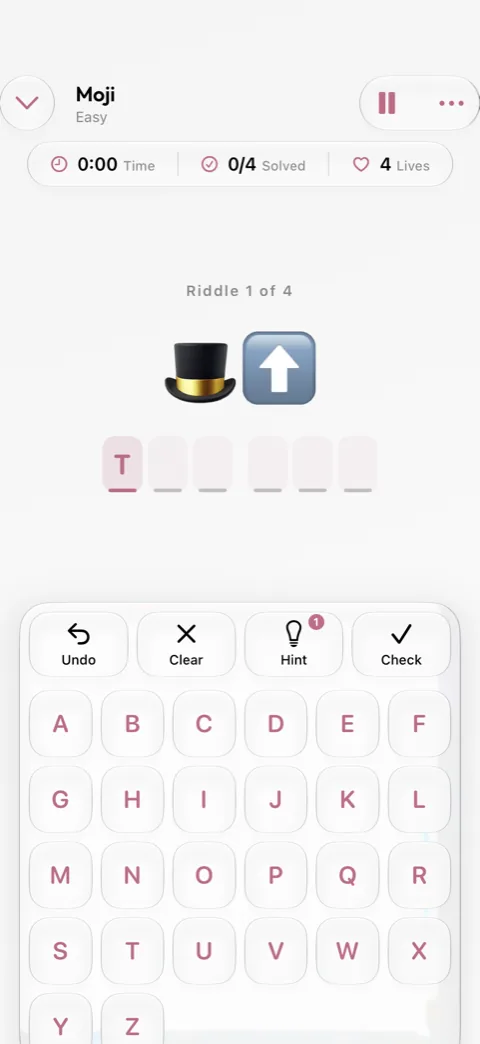
A rebus puzzle made of emoji. Read the pictures aloud and the sounds give you the phrase — a film, a saying, a song. It is the puzzle people most often make for each other, because a private joke works perfectly as a clue.
How it works
- Read the emoji aloud — the sound is the clue.
- Type the phrase into the blanks.
- A hint gives you a nudge, then fills a letter.
- Four wrong answers end the round.
Good if you want…
- Something playful rather than rigorous
- A puzzle to solve with someone else looking on
- Building an in-joke into a puzzle for a friend
How to solve Moji
Say it out loud
A Moji is a rebus: the pictures stand for sounds, not meanings. A bee and a leaf read as "belief"; an eye and a can read as "I can". Saying each picture's plainest name out loud, in order, gets you most of the way — the answer is usually hiding in the sound.
Try the other names
If the plain name does not work, try what else the picture could be called. A 🐝 is a bee, but also a bumblebee or a honeybee; a 🌊 is a wave, the sea or the ocean. Riddles often lean on the second name.
Count the blanks
The blanks tell you how many words the answer has and how long each one is. A phrase of three, two and five letters is a strong constraint: it rules out most of the readings that sounded right. Check your guess against the blanks before typing it in.
Writing your own
Moji is the puzzle people most often make for each other in Winters Puzzles. The best ones mix sound and meaning — one picture that is read literally, one that is a pun — and are about something the other person will recognise. A private joke makes a perfect clue precisely because nobody else could solve it.
Think about the category
Answers come from a few familiar kinds of phrase — films, songs, sayings, places and everyday expressions. Once you have a guess at one word, ask which kind of phrase it could belong to. Knowing the answer is a film title, say, turns a vague reading of the pictures into a short list of possibilities you can test against the blanks.
Common mistakes
- Reading the pictures for meaning. It is almost always the sound.
- Ignoring the blanks. The word lengths rule out more guesses than the pictures do.
- Using the hint straight away. The first tap is a nudge; only the second starts filling letters.
Where Moji comes from
Picture puzzles in which images stand for sounds are called rebuses, and they are centuries old — they appear in heraldry, printers' marks and Victorian parlour games. Emoji have simply given everyone a shared set of pictures to write them with.
Moji questions
How many guesses do I get?
Four wrong answers end the round.
What kind of answers are there?
Films, sayings, songs, places and everyday phrases.
Moji in Winters Puzzles
Moji is one of 40 puzzles in Winters Puzzles, so it sits alongside Word Search, Silhouette, Word Dominoes and everything else in the app rather than being a download of its own. It counts towards your stats and streak like any other puzzle. It is not one of the puzzle types included in Pip’s dailies.
Moji is also one of the 5 puzzles you can write yourself. Put in your own words or questions, try it, then send a link so someone else can play exactly what you made — see create and share.

Play Moji.
Free on iPhone and iPad, with 39 other puzzles alongside it. Or play it in your browser — no download, nothing to sign up for.