Runner
Also known as Endless Runner
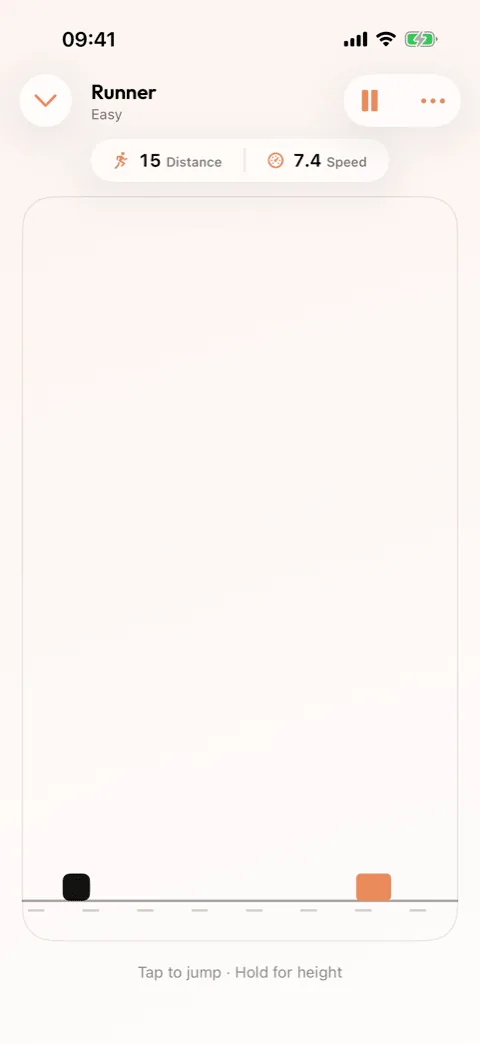
An endless run: jump the obstacles, and the world speeds up the longer you last. Some obstacles fly at head height, so staying on the ground is sometimes the right move. Every gap is clearable, so a collision is always a timing error rather than bad luck.
How it works
- Tap anywhere to jump. Hold for a full jump, tap lightly for a short hop.
- The world speeds up the longer you survive.
- Some obstacles fly at head height — stay on the ground to pass under them.
- Your score is the distance you cover. One collision ends the run.
- Obstacles are always spaced far enough apart to be cleared, so every run is winnable with good timing.
Good if you want…
- Reflexes rather than thinking
- A high score to chase
- One tap to learn
How to get better at Runner
Jump late, not early
The most common way to crash is to jump too soon and land on the obstacle rather than past it. Wait until the obstacle is close, then jump. As the world speeds up the right moment arrives sooner, but it is still later than it feels.
Match the jump to the obstacle
A light tap gives a short hop; holding gives a full jump. Low obstacles only need a hop, and a hop gets you back on the ground sooner, ready for whatever comes next. Save the full jump for tall obstacles and for pairs close together.
Sometimes the best move is nothing
Some obstacles fly at head height. Jumping into them is a crash; staying on the ground lets them pass over. Look at the height of an obstacle before reacting to it.
Watch further ahead as it speeds up
At higher speeds, reacting to what is right in front of you is too late. Shift your eyes further ahead, towards where obstacles appear, so you see each one coming and have your timing ready. Every gap is clearable, so a collision is always timing rather than bad luck.
Choosing a speed
The four tiers change how fast the run starts, how quickly it accelerates and how often the head-height obstacles appear — on the slowest tier they are occasional, on the fastest nearly half of what comes at you. If your runs keep ending in the first few seconds, drop a tier: the timing you learn there carries straight over, and a longer run teaches more than a quick crash.
A good way to practise is to pick one tier and stay on it until your best score stops improving, then move up. Jumping between tiers resets your sense of timing every time.
Think in rhythms
Obstacles come in patterns — a single low block, a pair close together, something overhead. Rather than reacting to each one separately, start to recognise the pattern as it arrives: a pair wants one full jump rather than two hops, and an overhead obstacle straight after a low one wants a hop and then a quick return to the ground.
Common mistakes
- Holding every jump. A full jump keeps you in the air longer than most obstacles need.
- Jumping at head-height obstacles.
Runner questions
How is Runner scored?
By the distance covered. One collision ends the run.
Can a run be impossible?
No. Obstacles are always spaced far enough apart to be cleared with good timing.
Runner in Winters Puzzles
Runner is one of 40 puzzles in Winters Puzzles, so it sits alongside Tower Stack, Threader, Rebound and everything else in the app rather than being a download of its own. It counts towards your stats and streak like any other puzzle. It is not one of the puzzle types included in Pip’s dailies.

Play Runner.
Free on iPhone and iPad, with 39 other puzzles alongside it. Or play it in your browser — no download, nothing to sign up for.