Rebound
Also known as Brick Breaker and Bricks
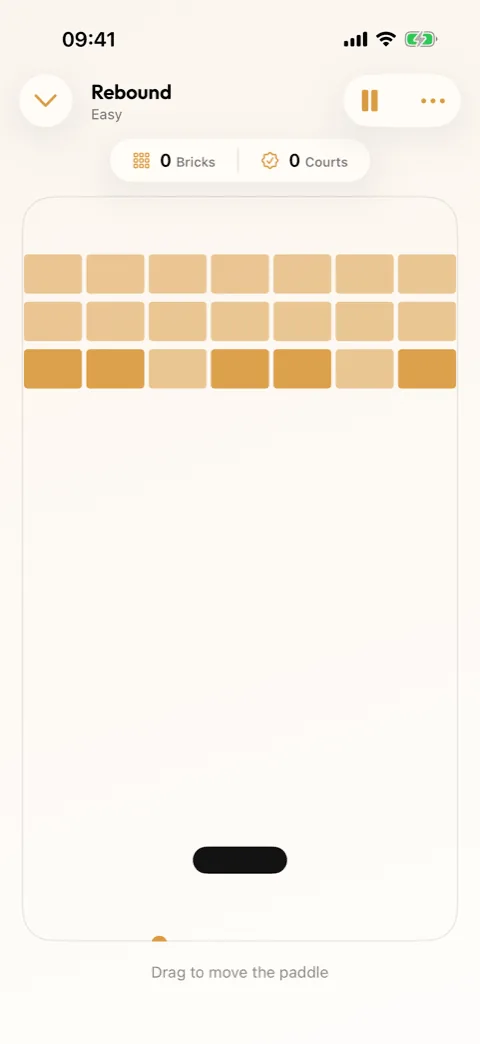
Bat and ball against a court of bricks. Where the ball meets the paddle sets its angle, so placement matters more than speed. Clear the court and a fresh one is dealt; every brick you break makes the ball quicker.
How it works
- Drag anywhere to slide the paddle along the bottom.
- Where the ball meets the paddle sets its angle — take it centre to send it straight back, near an edge to send it wide.
- Some bricks take two hits. Clear the whole court and a fresh one is dealt.
- Every brick you break speeds the ball up.
- Your score is the bricks broken. Lose the ball and the round ends.
Good if you want…
- A game you already know how to play
- Aiming rather than just reacting
- A score that keeps going as long as you do
How to get better at Rebound
Aim with the paddle
Where the ball meets the paddle sets its angle. Hitting it near the centre sends it back almost straight; near an edge sends it out wide. That means you can steer the ball — into a gap in the bricks, or towards the last few in a corner — rather than just returning it.
Break through to the top
If you can open a channel through the bricks to the space above them, the ball will bounce around up there, breaking bricks from behind without you having to do anything. Aim for one side of the court to cut that channel early.
Stay central when you can
Between hits, drift back towards the middle of the court. From the centre, the paddle can reach either wall in time; from one side, a wide ball to the other is often lost. As the ball speeds up with every brick, that head start matters more and more.
Choosing a speed
The tiers change how fast the ball starts, how much it speeds up with each brick and how deep the court of bricks is — three rows on the gentlest tier, six on the hardest. The paddle also moves faster on the harder tiers, so it can keep up, but the margin for a late move is smaller.
Deal with the sturdy bricks
Some bricks take two hits. They are brighter until they have been hit once, then fade. Leaving them for last is a mistake: they soak up two returns each when the ball is at its fastest. Aim at them while the court is still full and the ball is still slow.
Watch the ball, not the paddle
Your eyes should follow the ball and your hand should follow your eyes. Looking down at the paddle means you lose track of the ball's angle off the bricks, and that is the moment it gets past you. Try to judge where it will cross the bottom of the court as soon as it leaves a brick.
Common mistakes
- Chasing the ball rather than moving to where it will land.
- Always hitting with the centre. It is safe, but it leaves the corner bricks for last, when the ball is fastest.
Rebound questions
What happens when I clear the court?
A fresh one is dealt and the run carries on. Some bricks take two hits.
How is Rebound scored?
By the number of bricks broken. Lose the ball and the round ends.
Rebound in Winters Puzzles
Rebound is one of 40 puzzles in Winters Puzzles, so it sits alongside Runner, Tower Stack, Threader and everything else in the app rather than being a download of its own. It counts towards your stats and streak like any other puzzle. It is not one of the puzzle types included in Pip’s dailies.
Play Rebound.
Free on iPhone and iPad, with 39 other puzzles alongside it. Or play it in your browser — no download, nothing to sign up for.