Number Sequence
Also known as Number Series and Missing Number
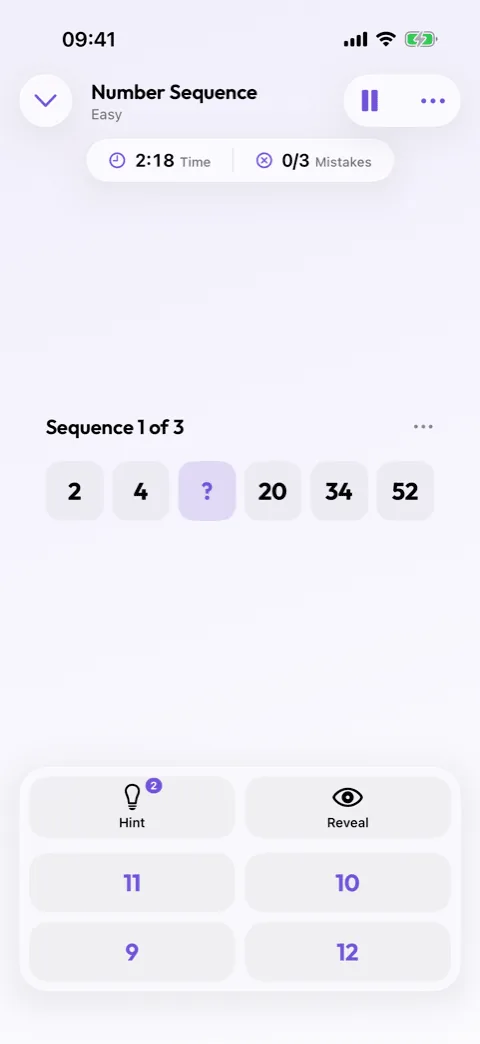
A run of numbers with one missing, and a rule connecting them that you have to spot. The pattern might be arithmetic, geometric, or something less obvious — and the blank is not always at the end, so sometimes you work inwards from both sides.
How it works
- Find the rule connecting the numbers in the sequence.
- Work out the missing term, then choose it from the four answers.
- Check the pattern on both sides of an internal blank.
- A hint explains the kind of pattern and removes one wrong answer.
- Choosing an incorrect number counts as a mistake.
Good if you want…
- A puzzle you can finish in a minute or two
- Spotting a pattern rather than grinding one out
- Writing your own sequence for someone else
How to solve Number Sequence
Write down the differences
The first thing to check is the gap between each term and the next. 3, 7, 11, 15 goes up by 4 each time. If the gaps are not constant, look at the gaps between the gaps: 2, 5, 10, 17, 26 has differences 3, 5, 7, 9, which themselves go up by 2 — the sequence is the square numbers plus one.
Then try ratios
If the numbers grow quickly, divide rather than subtract. 3, 6, 12, 24 doubles each time; 81, 27, 9, 3 divides by 3. Mixed rules exist too — 2, 5, 11, 23 doubles and adds one — and a ratio that is almost constant is usually a clue to one of these.
Know the famous sequences
A handful of sequences turn up again and again: square numbers (1, 4, 9, 16), cubes (1, 8, 27, 64), primes (2, 3, 5, 7, 11, 13), triangular numbers (1, 3, 6, 10, 15) and the Fibonacci-style run where each term is the sum of the two before it (1, 1, 2, 3, 5, 8). If the differences look irregular, check whether the terms themselves are on this list.
Look for two sequences at once
When nothing fits, try splitting the sequence into alternate terms. 1, 10, 2, 20, 3, 30 is two simple sequences interleaved. Rules that alternate — add 3, then double, then add 3 — show up the same way.
Check both sides of the gap
When the missing term is in the middle, a candidate has to agree with the term before it and the term after it. That is often what decides between two answers that both fit the start of the sequence. The four answers are a help here too: work out the rule, compute the term, and only then look at the options — rather than testing each option in turn.
Common mistakes
- Stopping at the first rule that fits the first three terms. Check the rule against every term you are given.
- Assuming the blank is at the end. It is often in the middle, and the terms after it are part of the evidence.
- Using the hint first. It removes one wrong answer and names the kind of pattern — worth saving for when you are genuinely stuck.
Number Sequence questions
Is there always one right answer?
Any finite list can be continued in more than one way if you allow rules complicated enough, which is why each round gives four answers to choose from: exactly one follows a simple rule that fits every term shown.
What kinds of rule come up?
Arithmetic steps, multiplying and dividing, square and cube numbers, primes, sums of earlier terms, and interleaved or alternating rules.
Number Sequence in Winters Puzzles
Number Sequence is one of 40 puzzles in Winters Puzzles, so it sits alongside Sudoku, Nonogram, KenKen and everything else in the app rather than being a download of its own. It counts towards your stats and streak like any other puzzle. It is not one of the puzzle types included in Pip’s dailies.
Number Sequence is also one of the 5 puzzles you can write yourself. Put in your own words or questions, try it, then send a link so someone else can play exactly what you made — see create and share.

Play Number Sequence.
Free on iPhone and iPad, with 39 other puzzles alongside it. Or play it in your browser — no download, nothing to sign up for.