Tessera
Also known as Domino Puzzle
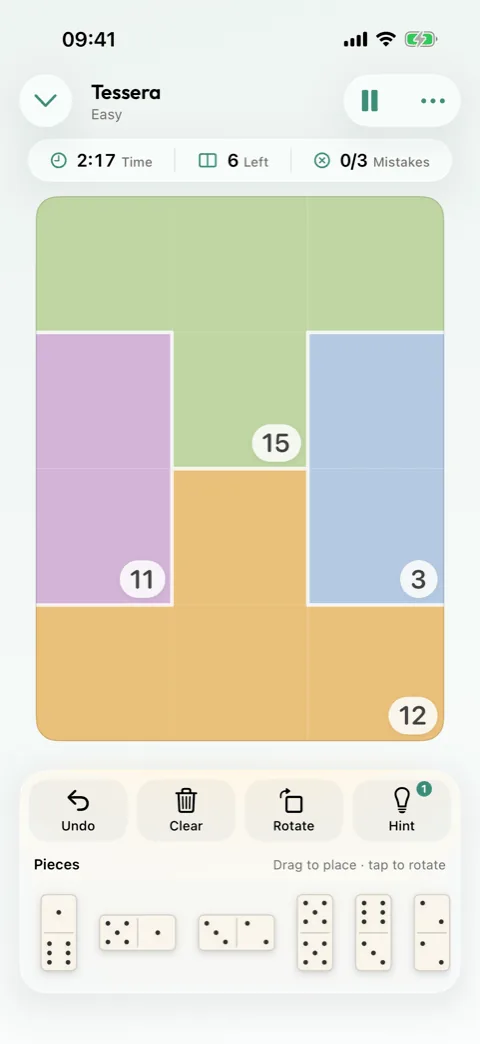
Cover the board with the tiles you are given, each used exactly once. The heavy outlines mark regions, and the numbers your tiles lay down have to satisfy each region's badge — a total, all-matching, all-different, or a rule each number has to meet on its own. Placing costs nothing, so it rewards trying things.
How it works
- Cover every cell of the board. Each tile is used exactly once.
- Tap a tile to hold it, then drag it onto the board. Tap a held tile again to turn it.
- Heavy outlines mark regions. The numbers covering a region must satisfy its badge.
- “12” — the covering numbers add up to 12. “=” all match, “≠” all differ.
- Placing costs nothing — try things freely. Cover the board, then press Check.
Good if you want…
- Something you almost certainly have not played before
- Shape-fitting with a logic constraint on top
- Experimenting rather than being punished for it
How to solve Tessera
Start with the regions that force themselves
Each half of a tile shows between zero and six pips, and that limit makes some regions decide themselves. A two-square region with a badge of 12 can only be 6 and 6. A region whose total is 0 must be covered entirely by blank halves. A two-square region marked "=" wants a matching pair — and if a single tile would cover both squares, it has to be a double.
Look for these before placing anything. They fix a tile or two in place, and every fixed tile takes a shape and a pair of numbers out of the tray.
Count the tray
Every tile is used exactly once, so the tray is a constraint just as much as the badges are. If a region needs two 6s and there is only one tile in the tray with a 6 on it, that tile must cover the region with its 6 — and the other 6 has to come from a tile whose far end lies outside. Checking what is left in the tray is often what decides between two placements that both satisfy the badge.
Use the less-than and more-than badges
A badge like "<4" means the numbers covering that region add up to less than 4. On a two-square region that rules out almost every tile half, so the squares want blanks, ones and a two at most. A ">" badge on a small region does the opposite, pulling in the high halves. These are weaker than an exact total but narrow things quickly.
Mind the shapes
Before thinking about numbers, think about coverage. A lone square in a corner, walled in on three sides, can only be covered by a tile running out of its one open side. A long thin corridor of squares can only be tiled one way. Settling the awkward shapes first means the numbers have fewer places to go.
Try things
Placing a tile costs nothing, and a region's badge turns red as soon as it can no longer be satisfied. Use that: lay a tile where you think it goes, watch the badges, and move it if something breaks. When the board is covered, press Check.
Common mistakes
- Placing the easy tiles first. The tiles that fit anywhere should go last; the ones that fit in one place should go first.
- Forgetting to turn a tile. Tap a held tile to rotate it — the same tile often fits a region one way round and not the other.
- Reading a region's badge as applying to each square. A number is the total for the whole region; = and ≠ compare every square in it.
Tessera questions
What do the badges mean?
A number is the total the covering halves must add up to. "<" and ">" set a limit on that total. "=" means every square in the region shows the same number, and "≠" means they are all different.
Can I get a Tessera wrong?
Placing costs nothing and there is no mistake limit, so you can try as many layouts as you like before pressing Check.
Tessera in Winters Puzzles
Tessera is one of 40 puzzles in Winters Puzzles, so it sits alongside Ripple, Flow, Shift and everything else in the app rather than being a download of its own. It counts towards your stats and streak like any other puzzle. It is not one of the puzzle types included in Pip’s dailies.
Play Tessera.
Free on iPhone and iPad, with 39 other puzzles alongside it. Or play it in your browser — no download, nothing to sign up for.