Memory Match
Also known as Concentration, Pairs, Pelmanism and Matching Pairs
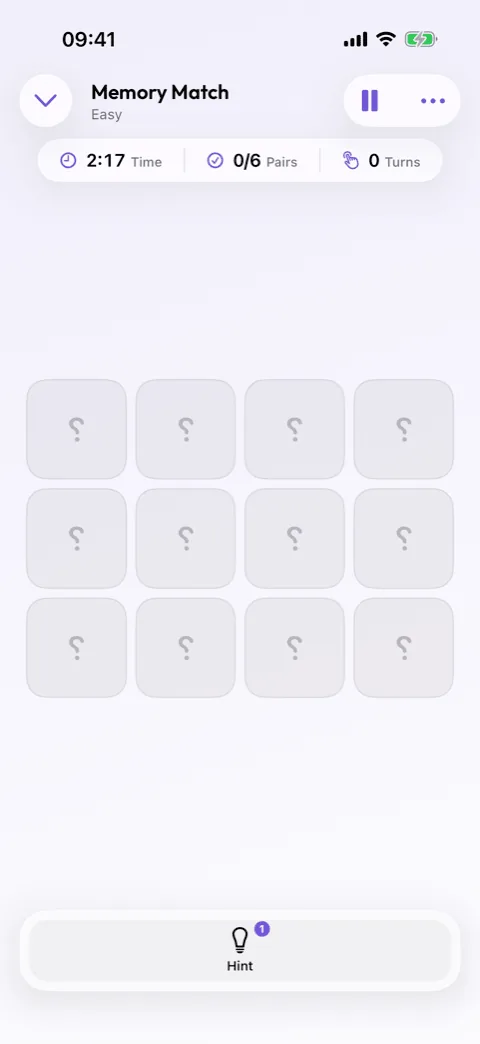
Turn over two cards, see what they hide, and remember where they were. Matching pairs stay face up; the rest turn back over. There is nothing to lose and no clock — the round is measured by how few turns it takes you, which makes it one of the gentlest games in the app.
How it works
- Turn over two cards to see what they hide.
- A matching pair stays face up.
- A mismatched pair turns back over — remember where they were.
- A hint pairs off one matching set for you.
- There is nothing to lose. The round is measured by how few turns it takes.
Good if you want…
- A couple of minutes and nothing to lose
- No reading and no rules to learn
- Playing alongside someone else
How to solve Memory Match
Sweep in order
Rather than turning cards at random, work through the board systematically — row by row, left to right. Your memory is much better at recalling "the third card in the top row" than a scattered set of positions, and a sweep guarantees you see every card once before you see any twice.
Turn the unknown card first
Each turn, flip a card you have never seen. If it matches one you remember, turn that one second and take the pair. If it does not, use your second flip on another unseen card rather than a known one — that way every turn reveals something new.
Say it to yourself
Naming what you see helps it stick. "Star, top left. Moon, second row, end." Linking a picture to a position with a word or a little story is the oldest memory trick there is, and it works just as well for a board of cards.
Do not rush the end
With only a few cards left, most of them are ones you have seen. Slow down and match the pairs you know before flipping anything new. There is no clock, and the round is measured only in turns.
Common mistakes
- Flipping a card you already know as your first card. It tells you nothing new.
- Guessing when you do not remember. Flip an unseen card instead; it is at worst no loss.
Where Memory Match comes from
The game has been played with ordinary playing cards for well over a century under names like Concentration and Pairs. In Britain it is also known as Pelmanism, after a memory-training course that was popular in the early twentieth century.
Memory Match questions
Is there a time limit?
No. There is nothing to lose — the round is measured by how few turns it takes.
How few turns can a round take?
With perfect memory, each pair costs at most two turns — one to see a card, one to match it — and lucky flips cost less. Most players take noticeably more, which is why beating your own best is the real game.
Memory Match in Winters Puzzles
Memory Match is one of 40 puzzles in Winters Puzzles, so it sits alongside Patch, Logic Grid, Pippin and everything else in the app rather than being a download of its own. It counts towards your stats and streak like any other puzzle. It is not one of the puzzle types included in Pip’s dailies.

Play Memory Match.
Free on iPhone and iPad, with 39 other puzzles alongside it. Or play it in your browser — no download, nothing to sign up for.